



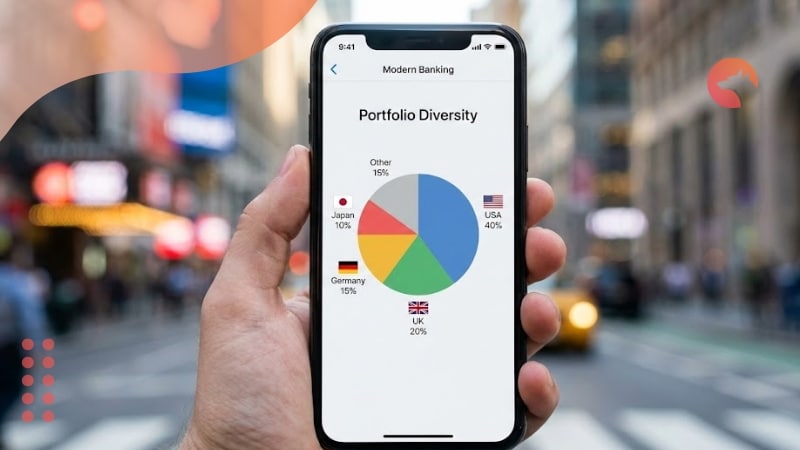
Knowing how to invest in foreign markets is the beginning for those who seek not only to protect their assets but also to find growth opportunities that cross domestic borders.
Understanding exactly how to invest in foreign markets requires you to know how the market currently is. Furthermore, you must know how to identify opportunities in the country. Only then will your money multiply.
In this guide, we will explain how to invest in foreign markets. From choosing the ideal modality to selecting the correct brokerage firm. Here, you will find analyses on funds, ETFs, ADRs, and the step-by-step process for opening your international account. Continue reading.
Main Investment Options to Start Abroad

1. International Funds and ETFs
This is the gateway for those who are starting to understand how to invest in foreign markets.
Mutual funds and international Exchange Traded Funds (ETFs) invest in diversified portfolios of companies outside the US.
As a rule, their advantage is simplification. They offer instant diversification and resolve the complexity of currency conversion, as many are traded in dollars.
Furthermore, it is important to distinguish that “global” funds may include North American stocks, while those classified as “international” normally exclude them.
Moreover, if this asset catches your attention, we recommend you see all the advantages of etf invesitng now.
2. American Depositary Receipts (ADRs)
ADRs function as receipts for foreign shares and are traded directly on North American stock exchanges.
For the investor who is studying how to invest in foreign markets. This modality allows you to buy stakes in large global companies using dollars, without the need to open an account in another country.
As a rule, the depositary bank responsible for the ADR handles the conversion of dividends into the American currency, facilitating the investor’s cash flow management.
3. Multinational and Cross-listed Stocks
A less obvious strategy, but cited by StockBrokers.com, is to invest in multinational American companies.
Moreover, many of these companies generate a significant portion of their revenue outside the US.
This offers indirect international exposure without the bureaucracy of currency exchange or external accounts.
Another alternative is cross-listed stocks, which are shares of the same company listed on exchanges in different countries, such as a Canadian company traded in both Toronto and New York.
4. Direct Purchase and OTC Stocks (How to invest in foreign markets)
For advanced investors who master investing in foreign markets, direct purchase on foreign exchanges offers a wider range of options.
However, this requires opening an account with a brokerage firm with access to that specific country and dealing with higher costs and currency conversion.
Foreign OTC (Over-the-Counter) stocks are securities not listed on the main US exchanges.
Brokerage Firms with International Options
Choosing the financial institution is a fundamental pillar in the process of how to invest in foreign markets.
We emphasize that the brokerage firm must not only accept clients from your country of origin, such as Brazil, but also be able to execute orders in the specific markets you wish to access. Below, we analyze the options highlighted in recent research.
Interactive Brokers (IBKR)
Elected as the best option for international trading, Interactive Brokers stands out for its breadth.
It offers access to over 90 global markets and provides advanced analytical tools for the investor.
Furthermore, the Global Trader application is a differential that facilitates the purchase of shares from various countries.
In this case, commissions vary according to the market traded and, a positive point, is that there is no minimum deposit requirement, democratizing access.
Charles Schwab (How to invest in foreign markets)
This brokerage firm is indicated for investors focused on the long term.
As a rule, Charles Schwab provides access to 12 international markets and maintains competitive commissions.
Moreover, the exchange rate practiced is around 1%, which is similar to that of competitors like Fidelity.
Furthermore, the process of opening a global account can be a little more bureaucratic, requiring the submission of paper documentation.
Fidelity Investments (How to invest in foreign markets)
Fidelity is presented as a complete brokerage firm, offering access to around 25 countries.
Initially, its strength lies in the robustness of the market research offered to clients and the quality of service.
Certainly, this is a platform recommended for those looking to invest in various countries, with the support of detailed reports. This way, you will be going beyond a focus only on the North American market.
TradeStation Global and Moomoo
TradeStation Global is aimed at experienced traders.
Through a partnership with Interactive Brokers, it offers a single account that provides direct access to the main exchanges in Europe, Asia, and North America, totaling over 90 market centers.
Tools like RadarScreen and EasyLanguage are attractive for those performing complex technical analyses.
Moomoo is an application that allows investing in domestic and international stocks with competitive fees, including support for buying fractional shares, as well as offering ETFs, options, and real-time news.
Comparative Table of Brokerage Firm Features
| Brokerage Firm | Main Highlights | Markets/Coverage | Notes |
| Interactive Brokers | Best for international trading; Global Trader App | +90 markets | No minimum deposit; variable commissions. |
| Charles Schwab | Long-term focus; Specialized support | 12 international markets | Exchange rate ~1%; requires physical documents for global account. |
| Fidelity Investments | Robust research; Quality service | ~25 countries | Commissions vary by country; ideal for a global view. |
| TradeStation Global | For experienced traders; Advanced tools | +90 market centers | Partnership with IBKR; integrated single account. |
| Moomoo | App with competitive fees; Fractional shares | Domestic and International | Includes ETFs, options, and real-time news. |
Conclusion (How to invest in foreign markets)
We saw that how to invest in foreign market is a strategy for diversification and the pursuit of growth, allowing access to sectors and economies that are not available domestically.
We covered everything from choosing assets like ETFs and ADRs to the careful selection of brokerage firms like Interactive Brokers and Charles Schwab, going through the essential precautions with costs, currency exchange, and regulation.
Investing globally is not an adventure. But, yes, a step toward financial maturity that requires study and caution with currency and political risks.
The key is to start with a solid foundation of information, choose reliable partners, and maintain discipline in the long term.
Evaluate the listed brokerage options today and start the account opening process to position your assets on a global scale.