



Entertainment marketing strategies for businesses replace advertising interruptions with cultural connection. Understanding these tactics is crucial for gaining visibility without generating rejection and achieving a competitive advantage.
Interest in these entertainment marketing strategies for businesses is growing because the public ignores traditional commercials, seeking emotional value or entertainment. Studying these methods allows companies to insert themselves into productions, social networks, and live events, ensuring relevance.
This guide will analyze the main entertainment marketing strategies for businesses, based on today. We will cover costs, returns, and tools to transform your brand into a popular culture icon.
With $45 Billion at Stake, Ad Market Trades Commercials for Narrative Integration

The US advertising market is undergoing a severe reconfiguration, swapping the interruption model for narrative integration.
With global spending projected at $45 billion in 2025 (12.3% annual growth), and 41% of American viewers ignoring ads, brands are inserting products directly into films, series, and digital content.
Modern effectiveness lies in the depth of insertion, not the frequency. While the media and entertainment sector is expected to generate $2.6 trillion in 2025, 42% of marketing budgets are migrating to digital channels, and 78% of companies are increasing spending on social media.
Integrated approaches outperform linear media: influencer partnerships generate a 5.1x return, and experiential marketing is 5.7x more likely to generate social shares than traditional ads. Brand value in the US is amplified by enhancing the leisure experience, rather than obstructing it.
AI is driving structural change, predicting successful productions (films/series) to optimize brand exposure. Furthermore, in tests, AI models predicted the ten highest-rated programs on American broadcast TV, guaranteeing advertisers greater security and mitigating risks in long-term investments.
Leading Entertainment Marketing Agencies and Platforms
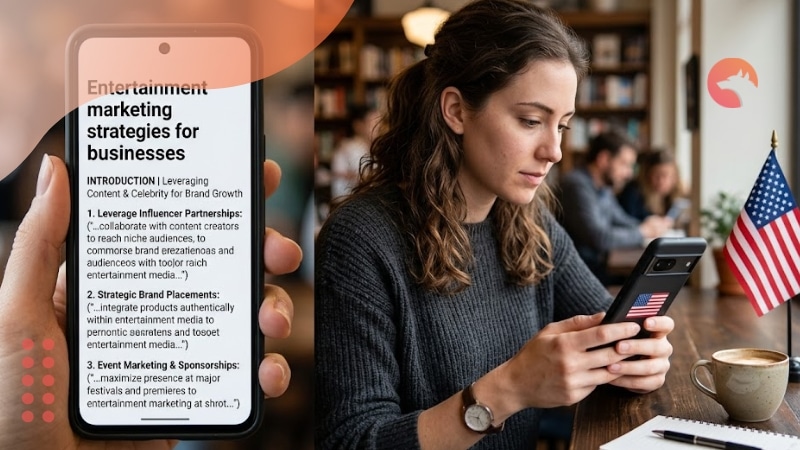
To navigate this complex ecosystem, companies need to select partners that offer reach and sophisticated measurement tools. Below, we detail the leading options in the United States market, focusing on their operational models and commercial effectiveness.
1. BENlabs (Entertainment marketing strategies for businesses)
BENlabs is a leader in product placement via AI, focusing on integrations that advance the plot to generate greater brand value, measured by Net Placement Value (discounts the cost of exposure from media value).
Research with YouGov indicates that standout integrations generate an average value of US$412,400, versus US$299,803 for standard placements.
A campaign for Maison Lillet in Emily in Paris increased sales by 58% and brand perception by 16%.
BENlabs operates with corporate budgets, with investments ranging from tens of thousands of dollars up to millions in global partnerships. Payments are on a Net-30 standard.
2. CreatorIQ
CreatorIQ is the leading platform for agencies and brands to manage influencer campaigns at scale.
Its differentiator is analytical depth and workflow automation, optimizing returns (often exceeding 10x with social commerce) by aligning creators and brands.
Annual licensing ranges from US$30,000 to US$36,000 (US$2,500 to US$3,000/month), with no free tier and annual billing upfront.
Creators receive an average of US$11,400 per mid-sized campaign.
3. Hollywood Branded (Entertainment marketing strategies for businesses)
Hollywood Branded is a consulting agency that inserts brands into popular culture via diagnostics and audience mapping, executing partnerships in entertainment (films, series, music, sports).
Success is measured by cultural icon status, as in the case of Pilot Pen and Mean Girls. Consultations with leadership cost starting from US$750/hour. A mandatory strategic workshop (2 to 4 weeks) integrates new clients.
Complete activations range from product loans to agency fees above US$1 million. Workshops are paid upfront; activations, by contractual milestones.
4. Wasserman
Wasserman is a global powerhouse in talent representation and partnership marketing, connecting brands to elite athletes and musicians.
Specializing in refined execution and exclusive access, the agency guarantees increased consumer trust and market authority through large-scale event activations (Super Bowl, Olympics, festivals).
As a rule, it operates as a full-service agency, with high management fees, and is aimed at global brands. Usual payment terms are Net-30 or Net-60. It guarantees multimillion-dollar endorsement contracts for its representatives.
5. Tinuiti
Tinuiti, the largest independent performance marketing agency in the US, manages approximately $4 billion in digital media.
Its focus is converting attention into sales and user acquisition, using advanced measurement to prove the value of investment on platforms like YouTube and social networks.
The agency optimizes the customer journey for financial results, serving brands with large budgets seeking immediate return.
Pricing models are based on a percentage of media investment or fixed performance fees. Billing is monthly, linked to media spend (Net-30).
6. GRIN (Entertainment marketing strategies for businesses)
GRIN, a relationship management tool for D2C brands, focuses on email automation and revenue tracking via discount codes, generating above-average returns. Its differentiator is operational efficiency.
Affiliate programs can achieve up to a 14:1 return. There is no free plan; annual plans range from US$2,200 to US$10,000+ per month. Annual contracts require upfront payment. Creators use a transparent portal to track commissions in real-time.
7. Aspire
Aspire has a vast creator marketplace, reversing the traditional search and saving marketing time. Brands report up to a 30% reduction in customer acquisition cost with user-generated content in paid ads.
The solution offers an e-commerce app, with plans starting from US$2,000/month (annual contracts/monthly or quarterly billing).
Micro-influencers can earn US$500 to US$5,000 per post without an agency. It is an efficient solution for rapid scaling.
8. United Entertainment Group: Experiential Marketing
UEG focuses on lifestyle marketing and physical experiences at events like Sundance or Coachella. The strategy aims to create lasting emotional memories, which digital ads cannot achieve. 74% of consumers who participate in brand experiences feel more likely to purchase.
The model is project-based (large activations), with a marketing cost of 15% to 20% of the total budget.
As a rule, payment is divided: 50% initial, 40% during production, and 10% upon completion. Participants gain access to exclusive experiences and infrastructure to generate social content.
How Much Does a Post Cost? The US Influence Pricing and Stratification Guide
A vital component of entertainment marketing is payment to content creators.
In the United States, rates are stratified based on reach and niche. The table below presents estimated payments for planning future campaigns.
| Category | Followers | Price per Post (Est.) | Average CPM |
| Nano-influencer | 1k – 10k | US$ 100 – US$ 500 | US$ 50 – US$ 200 |
| Micro-influencer | 10k – 100k | US$ 500 – US$ 5,000 | US$ 30 – US$ 100 |
| Mid-tier | 100k – 1M | US$ 5,000 – US$ 50,000 | US$ 20 – US$ 80 |
| Macro-influencer | 1M – 10M | US$ 50,000 – US$ 500,000 | US$ 15 – US$ 60 |
| Mega-influencer | 10M+ | US$ 500,000 – US$ 2M+ | Variable (Premium) |
The income distribution in this economy is unequal. Although the average annual income of a creator is US$44,293, the median is only US$3,000, indicating a concentration of wealth at the top.
In addition to per-post payments, there are models based on sales commissions and fixed monthly fees for constant ambassadors, ranging from US$1,000 to US$15,000 monthly.
Conclusion (Entertainment marketing strategies for businesses)
Entertainment marketing strategies are essential for growth in advertising saturation. Brands must focus on real commercial impact, authentic partnerships, and transparency, abandoning vanity metrics.
The choice of agencies/tools and respect for payments are crucial. In the US, protecting reputation with quality content is vital to survive in the multibillion-dollar market.
Choose the ideal tool/agency and plan your narrative integration to secure space in popular culture by 2026.
An important part of entertainment production is consuming content, so check out the top entertainment news website today now and stay informed.